Reef Filtration & Skimmers
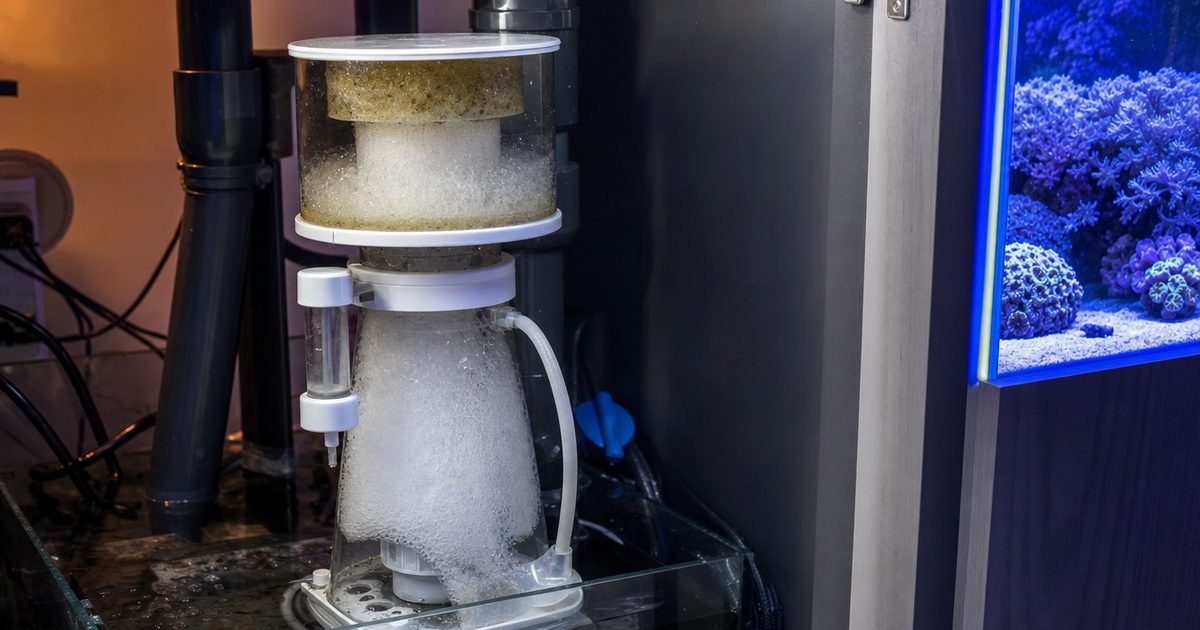
Filtration is where a reef build either gets a stable foundation or an undersized one. This silo explains reef tank filtration in plain English — what a protein skimmer actually does, in-sump versus HOB versus nano, how to size a skimmer to your real bioload, and where filter socks, media reactors and the return pump fit. The buying logic here is skimmer-first: get the skimmer sized right and the rest of the filtration follows. Specs are verified against manufacturer and current Amazon listings; no hands-on testing is claimed.
What a protein skimmer actually does
A protein skimmer is the heart of reef filtration, and it works on a simple idea: pull dissolved organic waste out of the water before it has a chance to break down into nitrate and phosphate. Inside the skimmer body, a pump injects a column of fine air bubbles. Organic molecules cling to the surface of those bubbles, the foam rises up the neck, and it tips over into a collection cup as a dark, smelly sludge you pour down the drain. That sludge is waste leaving the system entirely — which is why a skimmer is the single most effective mechanical-export device on a reef. On a closed system with no ocean to dilute it, export is everything, and the skimmer does more of it than anything else you'll run. That's the whole reason I treat filtration as skimmer-first rather than starting with media or socks.
Sizing a skimmer to your real bioload
Sizing is where most first reefs go wrong, mine included. Every skimmer carries a rated tank-volume band — "rated for 75–150 gallons", say — but that rating assumes a moderate fish load. Your real bioload is what actually matters: how heavily you stock, how big the fish are, and how much you feed. A heavily stocked, well-fed tank wants a skimmer rated well above its actual water volume; a lightly stocked tank can run nearer its rating. The safe error is always to size up. I bought an undersized skimmer on my first tank because it was cheaper, and an undersized skimmer is one of the most common reasons a first reef never quite finds its feet — the waste outpaces the export, nutrients climb, and the corals pay for it. Spec-by-spec, the figures that decide a skimmer are its rated tank-volume band, its pump and air-draw rating (more air generally means more skimming capacity), and its footprint in your sump. Match those to your bioload, not to your budget.
In-sump, hang-on-back or nano
The right skimmer type is decided first by your plumbing, then by your bioload. There are three families a beginner meets.
In-sump — the reef standard
An in-sump skimmer sits in the sump beneath the tank and is the standard for any reef with a sump. It gives the most performance and the largest collection-cup volume, runs out of sight, and keeps noise and salt creep below the display. If you're running a sump — and most reefs over nano size do — this is the default choice. The bigger water volume of a sump system also buys you stability, which is the whole point.
Hang-on-back (HOB) — for all-in-one and sump-less tanks
A hang-on-back skimmer clips onto the rim of the tank and suits all-in-one or sump-less builds where there's no room for an in-sump unit. It trades some cup volume and ultimate performance for the ability to run on a tank that was never plumbed for a sump. For a lot of first reefs that start as an all-in-one, an HOB skimmer is the realistic option.
Nano — small footprint, small cup
A nano skimmer is built for small-volume tanks where space and cup size are both limited. It's sized to a light bioload by design, so it's important not to overstock a nano and outrun the little skimmer. Match the skimmer type to your plumbing first, then confirm its rated band covers your stocking plan.
Filter socks, reactors and the return pump
The skimmer handles dissolved organics, but it isn't the whole filtration picture. Filter socks (or a roller) catch particulate detritus mechanically before it breaks down and feeds nutrients — a sock is cheap and effective but needs regular swapping; a roller automates that at a higher cost. Media reactors run carbon (for water clarity) or GFO (for phosphate control) as optional polish on top of the skimmer, not as a replacement for it. And the return pump moves water between the display and the sump, setting the baseline circulation that lets the skimmer and everything else do their job. Size the return pump to your sump and head height, and remember it counts toward — but rarely covers — your total flow and circulation needs. The order of priority stays the same: skimmer first, then mechanical (socks/roller), then chemical polish (reactors) only if your testing says you need it.
Featured guides
The current published guides in this silo. More land each batch.
Landing next: protein skimmer guide, how a protein skimmer works, best nano protein skimmer, in-sump vs HOB skimmer, filter sock vs roller, and best media reactor.
Frequently asked questions
What does a protein skimmer actually do?
A protein skimmer pulls dissolved organic waste out of saltwater before it breaks down into nitrate and phosphate. Fine air bubbles inside the skimmer body collect organics on their surface; the foam rises into a collection cup and carries the waste out of the system. It is the single most effective mechanical-export device on a reef, which is why filtration here is "skimmer-first".
How do I size a protein skimmer to my tank?
Size to your real bioload, not just the tank label. A skimmer is rated for a tank-volume band assuming a moderate fish load; a heavily stocked tank wants a skimmer rated well above its actual water volume, while a lightly stocked tank can run nearer its rating. Sizing up is the safer error — an undersized skimmer is one of the most common reasons a first reef struggles.
In-sump, hang-on-back or nano skimmer — which do I need?
It depends on whether you run a sump. An in-sump skimmer is the standard for any tank with a sump and gives the most performance and cup volume. A hang-on-back (HOB) skimmer suits all-in-one or sump-less tanks. A nano skimmer is built for small-footprint tanks where space and cup size are limited. Match the skimmer type to your plumbing first, then to your bioload.
Do I still need filter socks and a return pump?
Yes — the skimmer handles dissolved organics, but filter socks or a roller catch particulate detritus before it breaks down, and the return pump moves water between the display and the sump so the skimmer and other gear can do their job. Media reactors (for carbon or GFO) are optional polish on top. These are general reef-keeping guidelines, not a prescription for your specific tank.
A protein skimmer is one of the few pieces of gear that simply doesn't exist in freshwater — there's no dissolved-organic foam to pull off fresh water the way there is off saltwater. If you keep a planted tank as well, filtration over there is a different discipline entirely; Planted Tank Hub covers canister filtration and CO2 for freshwater aquascaping as our sister site. Coral & Flow stays strictly saltwater reef.