Reef Stability & Livestock Support
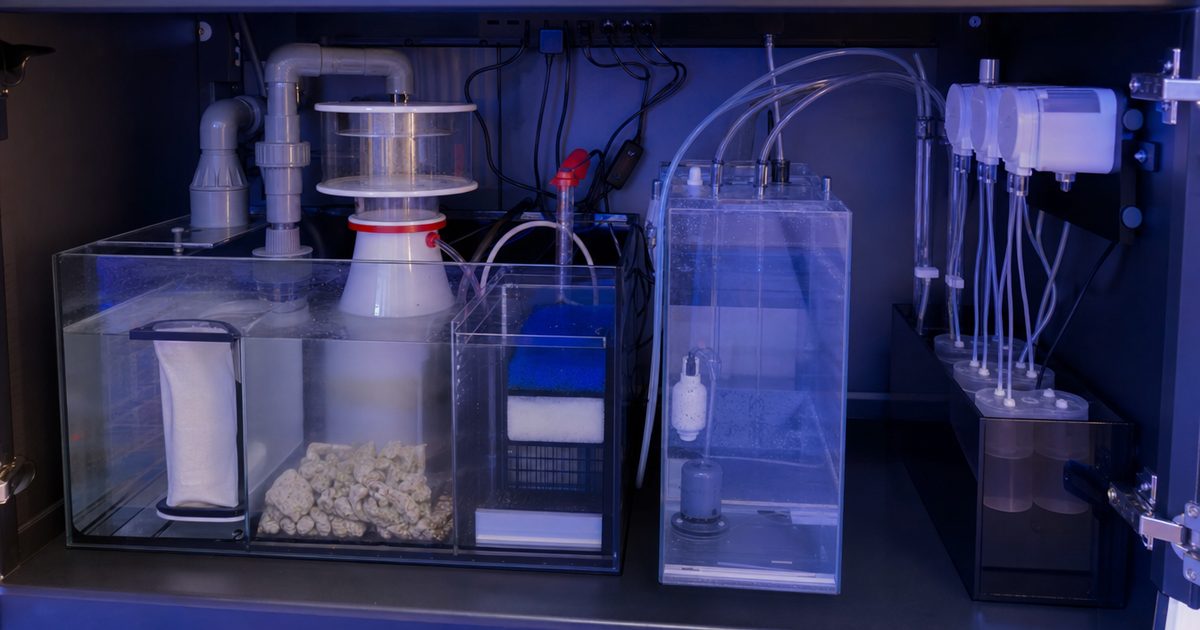
Stability gear, not livestock, makes the reef. This silo explains how to keep a reef stable in plain English — heaters and controllers, ATO to hold salinity, dosing for growing corals, test kits and target reef tank parameters, salt and media. It also owns the reef Tools. Specs are verified against manufacturer and current Amazon listings; no hands-on testing is claimed, and livestock guidance is general reef-keeping information, not veterinary advice.
Steady beats perfect
Here's the idea the whole site is built on: a reef thrives on parameters that stay steady, not on parameters that are perfect for one reading and bouncing the next. Coral and the algae living inside it adapt to a slightly-off value held constant far better than they tolerate a swing, even a swing between two "good" numbers. A tank parked at 8.5 dKH all week is healthier than one ping-ponging between 7 and 10. That single insight changes how you buy: you're not shopping for gear that hits a magic number once, you're shopping for gear that holds — a heater that doesn't drift, an ATO that keeps salinity flat, dosing that replaces what corals consume before the parameter sags. The early temptation is to chase numbers and tweak constantly; the cure is to set the stability stack up properly and then leave the tank alone to settle.
Heaters and controllers
Temperature is the parameter that swings fastest and stresses coral hardest, so the heater is the foundation of the stack. A common rule of thumb is roughly 3–5 watts per gallon, adjusted for room temperature and tank size, and many reefers split that across two heaters for redundancy so a single failure can't crash the tank. The reef standard is a titanium heater paired with a separate controller: titanium resists saltwater corrosion and won't shatter, and an external controller holds temperature tightly and — critically — cuts power if the heater sticks on. A stuck heater is one of the few failures that can cook a whole tank overnight, which is exactly why the controller earns its place.
ATO: holding salinity steady
As water evaporates, salt stays behind — so an un-topped tank slowly drifts saltier, and salinity is one of the parameters coral cares about most. An auto top-off (ATO) automatically replaces evaporated water with fresh RODI from a reservoir, keeping salinity flat without you topping off by hand twice a day. It's one of the highest-value, least glamorous upgrades on a reef. The ATO that quietly held my salinity while I was away for a week is the reason I came home to a stable tank rather than a salt-creep problem. Size the reservoir to your evaporation rate and the longest gap you want to leave it unattended, and use a backup float or sensor so it can't overfill.
Dosing for growing corals
Growing corals pull calcium, alkalinity and magnesium out of the water to build their skeletons. At first, regular water changes usually replace what they use. But as the coral load grows — especially with LPS and SPS — consumption outpaces water changes, and the parameters start to sag between them. A dosing pump adds those elements in small, steady amounts (commonly a two-part calcium-and-alkalinity supplement, plus magnesium as needed) so the chemistry stays level instead of drifting. Dosing is about holding the numbers, not chasing a perfect one: measure consumption, set the dose to match it, and re-check. The salinity & dosing calculator does the generic dosing-rate math, with a follow-your-product's-label caveat.
Test kits, salt and target parameters
You can't hold what you don't measure, so a basic reef test kit is part of the stability stack, not an extra — alkalinity, calcium and magnesium for day-to-day, plus ammonia/nitrite/nitrate while cycling. Test consistently with the same kit and watch the trend rather than reacting to a single reading. Mix water changes from a quality reef salt to a consistent salinity, and add carbon or other media only if testing says you need it. Widely used reef targets are roughly: temperature 76–78°F, salinity 1.025 SG, alkalinity 8–9 dKH, calcium 420–440 ppm, magnesium 1300–1400 ppm. Treat those as bands to hold steady, not bullseyes to chase. This is general reef-keeping information — test your own water and follow product labels.
The Tools live here
Because stability is where the numbers come together, this silo owns the reef Tools. The Reef Matcher takes your tank volume and coral type and returns turnover, skimmer rating band, return-pump GPH, PAR target, heater wattage, ATO sizing and a welfare-conscious stocking ceiling — every parameter from across the four silos in one place. The salinity & dosing calculator works out salt mix for a water change and dose volumes from your current-versus-target dKH, calcium and magnesium. Both are parameter-based and sourced to established reef rules, with a parameter-not-prescription disclaimer — general reef-keeping information, not veterinary advice.
Featured guides
The current published guides in this silo. More land each batch.
Landing next: reef tank parameters explained, best ATO, best dosing pump, titanium heater guide, best reef test kit, how to dose a reef tank, and best aquarium controller.
Frequently asked questions
What does it mean to keep a reef stable?
Stability means holding temperature, salinity and the key parameters (alkalinity, calcium, magnesium) steady over time rather than chasing perfect single numbers. Swings stress coral far more than a value that is slightly off but constant. The stability stack — a reliable heater, an ATO to hold salinity, dosing to replace what corals consume, and test kits to track it — is what keeps a reef alive. These are general reef-keeping guidelines, not veterinary advice.
How big a heater does my reef need?
A common rule of thumb is roughly 3–5 watts per gallon, adjusted for room temperature and tank size, often split across two heaters for redundancy. A titanium heater paired with a separate controller is the reef-standard setup because it fails safe and holds temperature tightly. Always follow the manufacturer's instructions.
Do I need an ATO and a dosing pump?
An auto top-off (ATO) replaces water lost to evaporation with fresh RODI, which keeps salinity stable — one of the highest-value stability upgrades. A dosing pump becomes important once corals grow enough to consume measurable calcium and alkalinity; until then, regular water changes may keep up. Both are about holding parameters steady.
What are the target reef parameters?
Widely used reef targets are roughly: temperature 76–78°F, salinity 1.025 SG, alkalinity 8–9 dKH, calcium 420–440 ppm, magnesium 1300–1400 ppm. The exact figures matter less than keeping them steady. The Reef Matcher and the salinity & dosing calculator help you work to these targets. This is general reef-keeping information — test your own water and follow product labels.
The chemistry here — salinity, alkalinity, calcium and magnesium dosing — is specific to saltwater; a freshwater planted tank tracks a different parameter set entirely (think CO2, pH and plant nutrients). If you keep both, Planted Tank Hub is the freshwater-aquascaping sister site for that side of the chemistry. Coral & Flow stays strictly saltwater reef.