Best Reef Lights
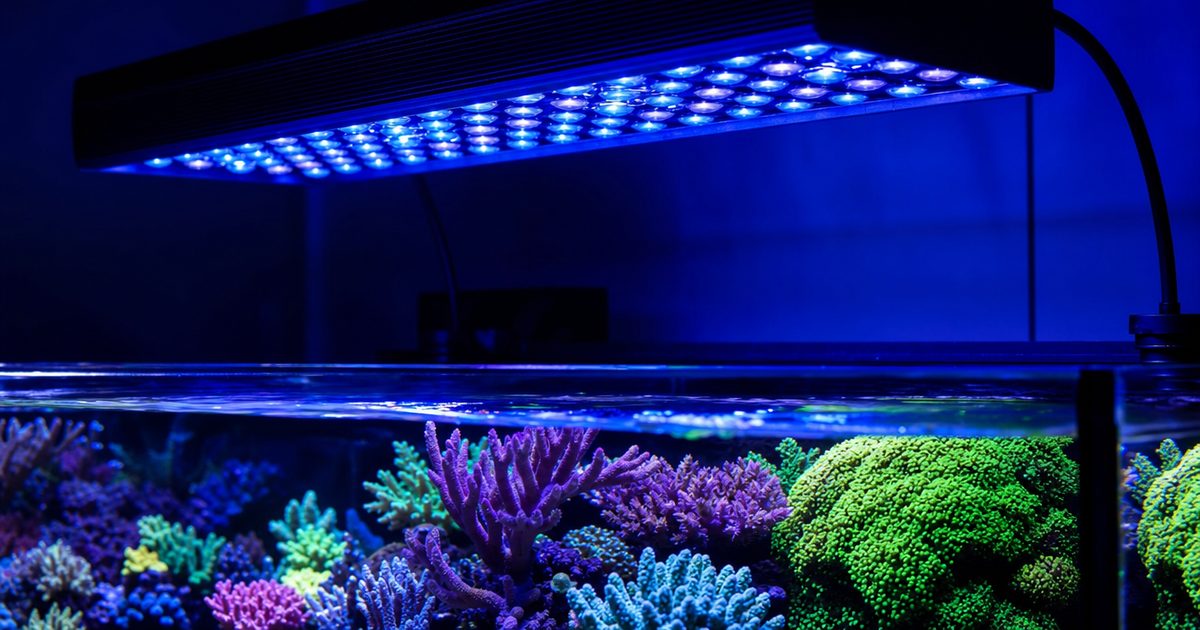
The right reef light delivers the PAR and spectrum your corals need over your exact footprint — no more, no less. The best reef aquarium light is not the brightest fixture on the shelf; it is the one matched to your hardest-to-please coral group and sized to cover your whole tank evenly. This guide explains the specs that decide the fit — PAR, spread, spectrum, wattage, control and coverage — then matches them to five categories: best overall, best budget, best for SPS, best nano and best value puck. The verified picks appear in each slot once real product data is in.
A note on how to read this. There is no single "best" reef light for everyone — the right one depends on which corals you keep, the footprint you need to cover, whether you want a single fixture or pucks, and your budget. So the value here is the framework: what each spec changes, so you can shortlist a light that suits your tank. Read the framework first, then look at the picks. Lighting is also where new reefers do real harm by overdoing it. On my own first tank I was impatient — running too much light, too soon, on a tank that had not matured — and it fed an algae bloom while I was busy chasing numbers everywhere else. That is the whole reason this guide leads with PAR-by-coral-type and a slow ramp instead of "more light is better".
Specs verified against manufacturer details and current Amazon listings — no hands-on testing claims. PAR, spectrum and coverage figures are derived from published specs and established reef guidelines, not bench measurement. Livestock guidance is general reef-keeping information, not veterinary advice.
How to choose a reef light
A handful of specs decide whether a light suits your reef. These are exactly the columns in the comparison below, and reading them in the right order — coral group first, then coverage — is most of the job.
PAR by coral type — the number that matters most
PAR (photosynthetically active radiation) is the measure of usable light reaching your corals, and it is the figure to design around — not watts at the surface. Different corals want different PAR: as a rough guide measured at the coral, soft corals and many LPS thrive around 50–150 PAR, while SPS want roughly 150–300 and up. Spec-by-spec, a fixture that can deliver your hardest coral's PAR band over its mounting height is the one that will keep that coral healthy; a fixture that tops out below it will leave SPS browning out no matter how it looks to your eye.
The honest rule is to choose the light for your most demanding coral, then dial it down for the rest of the tank. Picking a light that only just reaches soft-coral PAR locks you out of SPS later without buying again. The Reef Matcher gives a PAR target for your reef type as a starting point, and the reef lighting hub walks the soft / LPS / SPS difference in plain English.
Coverage and spread — lighting the whole footprint
Coverage is the tank footprint a fixture can light at its rated PAR, and spread is how evenly that light falls across the area. These two specs decide whether every coral in the tank gets what it needs or only the ones under the bright centre. A spread-style fixture covers a wider footprint evenly and suits longer tanks; a high-PAR puck concentrates light over a smaller area with more shimmer and suits cubes, nano tanks, or ganging in multiples over a long tank.
The trap is buying a single fixture for a tank longer than it can cover, leaving dim ends where corals struggle. Measure your tank footprint first, then match the light's rated coverage to it — and if one fixture cannot cover a long tank, two pucks or two fixtures usually beat one overstretched unit. Coverage is the spec that quietly decides how many fixtures the tank actually needs.
Spectrum — colour, growth and how the tank looks
Spectrum is the mix of colours the light produces, and reef corals respond to a blue-heavy spectrum — strong in the 400–480nm blue and violet range that drives coral fluorescence and growth. The spec to look for is the channel layout: a fixture with separate blue, violet, white and other channels lets you bias toward blue for coral colour while keeping enough white for the tank to look natural to your eye.
In practice spectrum is about the corals first and your viewing preference second, and a controllable LED lets you tune both. A fixed-spectrum light can still grow coral if its blue content is right, but you lose the ability to shift the look or ease the spectrum on a young tank. Read spectrum together with control rather than on its own.
Wattage and control — power draw and the slow ramp
Wattage tells you roughly how much fixture you are buying and what it will cost to run, but it is a poor proxy for PAR on its own — optics and efficiency change how much of that wattage reaches the coral. Control is the more useful spec for a first reef: a controllable light lets you ramp intensity at sunrise and sunset, run a gentler photoperiod while a tank matures, and step corals up slowly.
That ramping is exactly what avoids the over-lighting and algae trap that catches so many new tanks. Spec-by-spec, the value of control is not a feature checkbox — it is the difference between easing a young reef in safely and blasting it at full power from day one. For a first build, a controllable light earns its place for the slow ramp alone.
The lights compared
A short list of widely available reef lights, compared on the specs above. Specs are verified against manufacturer details and current Amazon listings — no hands-on testing claims. Verified picks land once real product data is in.
| Best for | PAR | Spread | Spectrum | Wattage | Coverage |
|---|---|---|---|---|---|
| Best overall | Not listed | Wide coverage | Full spectrum (incl. blue/UV) | 140 W | Large / standard reef tank |
| Best budget | Not listed | Standard | Full spectrum | 100 W | Mid-size reef tank |
| Best for SPS | Not listed | Standard | 5-channel tunable (heavy blue/UV) | 100 W | SPS-depth reef tank |
| Best nano | Not listed | Nano footprint | Full spectrum | 36 W | Nano reef tank |
| Best value puck | Not listed | Puck (focused) | Cree marine spectrum | 30 W | Nano / supplemental puck |
Our top picks
Best overall: SMATFARM Aquarium Light 140W Reef Light Wide Coverage Full Spectrum LED for Saltwater Coral Tank

Best overall
SMATFARM Aquarium Light 140W Reef Light Wide Coverage Full Spectrum LED for Saltwater Coral Tank
SMATFARM
- PAR: Not listed
- Spread: Wide coverage
- Spectrum: Full spectrum (incl. blue/UV)
- Wattage: 140 W
- Control: Timer / app dimming
- Coverage: Large / standard reef tank
The SMATFARM 140W is a high-output full-spectrum reef light with wide coverage and programmable dimming. It suits reefers lighting a standard-to-large display who want strong coral growth output in one fixture.
Last checked 2026-06-15
Best budget: Wills Aquarium Light, 100W Full Spectrum LED Reef Light for Saltwater Coral Tank

Best budget
Wills Aquarium Light, 100W Full Spectrum LED Reef Light for Saltwater Coral Tank
Wills
- PAR: Not listed
- Spread: Standard
- Spectrum: Full spectrum
- Wattage: 100 W
- Control: Timer / dimming
- Coverage: Mid-size reef tank
The Wills 100W full-spectrum light delivers reef-capable output at under $90. It suits budget reefers lighting a mid-size soft/LPS tank without spending on a premium fixture.
Last checked 2026-06-15
Best for SPS: Hipargero Aquarium Lights 100W 5 Channels Sunrise Sunset LED Reef Light for SPS LPS Coral

Best for SPS
Hipargero Aquarium Lights 100W 5 Channels Sunrise Sunset LED Reef Light for SPS LPS Coral
Hipargero
- PAR: Not listed
- Spread: Standard
- Spectrum: 5-channel tunable (heavy blue/UV)
- Wattage: 100 W
- Control: 5-channel sunrise/sunset programming
- Coverage: SPS-depth reef tank
The Hipargero 100W uses five independently tunable channels and a heavy blue/UV spectrum suited to demanding SPS corals. It suits reefers running SPS who need spectral control and acclimation ramping.
Last checked 2026-06-15
Best nano: Aquarium Light A036 Reef Tank Light 36 Watts Full Spectrum LED for Nano Saltwater Coral Tank

Best nano
Aquarium Light A036 Reef Tank Light 36 Watts Full Spectrum LED for Nano Saltwater Coral Tank
A036
- PAR: Not listed
- Spread: Nano footprint
- Spectrum: Full spectrum
- Wattage: 36 W
- Control: Timer / dimming
- Coverage: Nano reef tank
The A036 36W is a compact full-spectrum light sized for nano reef tanks. It suits small-tank reefers who need coral-capable light over a limited footprint.
Last checked 2026-06-15
Best value puck: Corals Chat Aquarium Reef LED Light, 30W Cree Spectrum Marine Saltwater Coral Light with Timer and Sunrise Sunset Control for LPS/SPS Nano Tank

Best value puck
Corals Chat Aquarium Reef LED Light, 30W Cree Spectrum Marine Saltwater Coral Light with Timer and Sunrise Sunset Control for LPS/SPS Nano Tank
Corals Chat
- PAR: Not listed
- Spread: Puck (focused)
- Spectrum: Cree marine spectrum
- Wattage: 30 W
- Control: Timer + sunrise/sunset
- Coverage: Nano / supplemental puck
The Corals Chat 30W is a Cree-based puck light with built-in timer and sunrise/sunset control at a value price. It suits nano tanks or reefers adding a supplemental puck over a specific coral zone.
Last checked 2026-06-15
Who should buy what
The mixed-reef beginner — match the light to your toughest coral
If you are starting a mixed reef of softies, LPS and maybe a few SPS, the best overall slot points to a controllable fixture that reaches SPS-level PAR and covers your footprint. Spec-by-spec, buying for your most demanding coral means you can dial the light down for the soft corals and LPS, but you are never locked out of SPS later. This is the configuration that grows with the tank rather than capping it.
The honest trade-off is cost and the discipline to ramp it in slowly — a strong light on a young tank is exactly what feeds algae if you run it at full power too soon. Buy the capable fixture, then use its control to ease the tank in. That patience is the difference between a light that helps and one that triggers the new-tank algae bloom.
The SPS-focused reefer — high PAR and tight spectrum control
The best for SPS slot suits the reefer chasing stony-coral growth and colour. SPS are the most light-hungry corals, wanting roughly 150–300+ PAR at the coral, so the figures that matter are peak PAR and a spectrum with strong blue and violet channels. Spec-by-spec, an SPS light has to deliver high PAR evenly across the footprint, because a hot centre and dim ends gives you patchy SPS health.
The trade-off is that SPS lighting is less forgiving — high PAR demands a stable, well-circulated, mature tank underneath it, or you trade algae and bleaching for growth. SPS is the discipline where flow and stability matter most, so the light is only worth buying once the rest of the system can support it. Build the stable tank first, then push the light.
The nano and cube reefer — high PAR over a small footprint
The best nano and best value puck slots suit small tanks and cubes. On a compact footprint a single puck or nano fixture delivers strong, shimmery PAR over the whole tank, and the spec that matters is coverage matched to the small footprint rather than raw spread. A puck's tight, intense beam is an advantage here, not a drawback.
The trade-off is that nano tanks are less forgiving of over-lighting because the small water volume swings fast. My own first reef was a nano, and the lesson it taught me was to ramp the light in gently and let the tank mature rather than running it hard early. Match the puck to the footprint, ramp slowly, and a nano light does its job without triggering an algae bloom.
The budget first build — protect PAR and control, not features
The best budget slot is for the first-time reefer keeping costs down. On a budget the figures to protect are PAR for your corals and basic control for the slow ramp — everything else is negotiable. Spec-by-spec, a budget light that hits your coral's PAR band and lets you ramp the photoperiod beats a flashier fixture that under-delivers PAR or runs only on/off.
The trade-off is fewer channels, less even spread or a cruder app, so shop for PAR and coverage first and accept the missing extras. A correctly-specced budget light grows coral; an underpowered premium-looking one does not. Buy the PAR right once and the budget fixture earns its place over the tank.
What to buy alongside the light
Light grows coral, but only on a stable, well-circulated tank — it is one link in the cart-stack, not a shortcut around the rest. Dial in flow with the best wavemaker for your reef tank so corals get the random turbulent motion they need to use the light, and hold temperature steady with the best reef tank heater, because instability undoes everything good light does. Not sure on the target? Work out your PAR target with the Reef Matcher.
Frequently asked questions
What is the best reef light for beginners?
The best reef light is the one that delivers the right PAR and spectrum over your tank footprint for the corals you keep. Soft corals and LPS need less; SPS need more. Match the light to your hardest-to-please coral group and to your coverage, then ramp it in slowly. Spec-by-spec, a fixture rated to cover your footprint at the right PAR band is what keeps every coral in the tank lit evenly, rather than a bright centre and shaded corners. Verified picks land once real product data is in. These are general reef-keeping guidelines, not a prescription for your specific livestock.
How much PAR do my corals need?
As a rough guide measured at the coral, soft corals and many LPS thrive around 50–150 PAR, while SPS want roughly 150–300 and up. PAR at the coral, not watts at the surface, is the figure that matters — two fixtures with the same wattage can deliver very different PAR depending on optics and mounting height. Acclimate corals up to higher light slowly rather than dropping a new frag straight under peak intensity. The Reef Matcher gives a PAR target for your reef type as a starting point.
Fixture or puck light for my tank?
It comes down to your footprint. A spread-style fixture covers a wider area evenly and suits longer tanks, where a single puck would leave shaded ends. A puck delivers high PAR over a smaller area with more shimmer and suits cubes and nano tanks, or it can be ganged in multiples over a longer tank. Coverage and spread are the specs that decide which fits — measure your tank footprint first, then pick the form factor that lights all of it.
Can I over-light a reef tank?
Yes, and it is one of the most common new-tank mistakes. Over-lighting a young tank fuels nuisance algae before corals can use the light, and blasting new corals at full intensity can bleach them. Start with a shorter photoperiod and lower intensity, then ramp up over weeks as corals settle in and the tank matures. This is general reef-keeping information — observe your own tank and adjust, rather than running a new light at full power from day one.
What spectrum is best for coral colour and growth?
Reef corals respond to a blue-heavy spectrum — heavy on the 400–480nm blue and violet range that drives coral fluorescence and growth, with enough white and other channels to keep the tank looking natural to your eye. A controllable LED lets you bias toward blue for colour while keeping a little white for viewing. The point is that spectrum is about the corals first and how the tank looks to you second; a fixture with adjustable channels lets you tune both rather than locking you to one look.
How high should I mount a reef light?
Mounting height trades off PAR against spread: mounted lower, a fixture pushes higher PAR over a narrower area; mounted higher, the same light spreads wider but at lower PAR. Most fixtures publish a recommended mounting height for their rated coverage, and that is the place to start. The reason it matters is that height changes the PAR your corals actually receive without changing the spec on the box — so measure or follow the manufacturer's guidance rather than guessing.
Do I need a controllable light, or is on/off enough?
Controllability is not strictly required, but it earns its place. A controllable LED lets you ramp intensity at sunrise and sunset, run a gentler photoperiod on a young tank, and dial the spectrum — all of which help you avoid the over-lighting and algae traps and acclimate corals safely. A simple on/off light can grow coral, but you lose the ability to ease a new tank in slowly. For a first reef, the ramping alone is worth it.