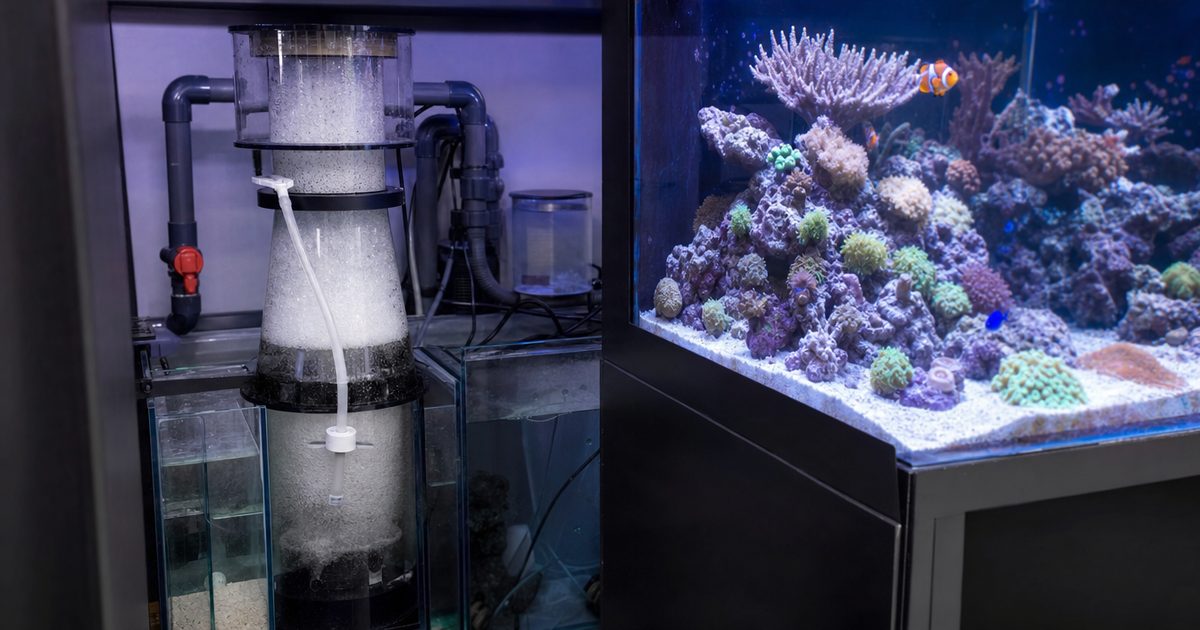
When I bought the protein skimmer for my first reef, I did the thing that feels smart and is actually a trap: I looked at the rated tank size on the box, found one that said “up to” my gallons, and bought the cheapest one that cleared the bar. I saved maybe forty dollars. It cost me a lot more than that.
What a skimmer actually does, and why size matters
A protein skimmer pulls dissolved organic waste out of the water before it breaks down into nitrate and phosphate. It works by injecting a column of fine bubbles into the water; organic compounds stick to the bubble surfaces, ride up into the neck, and overflow into a collection cup as that brown gunk every reefer learns to love. The more air a skimmer can process and the longer the contact time, the more waste it exports.
The rated tank size on the box is the manufacturer’s best-case number. It usually assumes a light bioload, a generous skimmer body, and ideal water depth in the sump. Real tanks are messier. A reef with a decent fish load, daily feeding and a few hungry corals produces far more waste than the lab-bench assumption behind that rating.
The false economy in practice
Here’s how the saving turned into a cost on my first tank. My skimmer was rated right at my tank’s volume, so it had no headroom. Once I had fish in and was feeding properly, it simply couldn’t keep up. The collection cup barely filled. Nutrients climbed. Algae took hold on the rocks and glass. The water never got that clean, polished look the healthy tanks at my club had.
So I did more water changes to compensate — which costs salt and time. I added filter media to chase the nutrients the skimmer should have been exporting — which costs money on an ongoing basis. And eventually, after the tank crashed for a stack of reasons including this one, I bought a bigger skimmer anyway. I paid for two skimmers, more salt, and a pile of media, to avoid spending forty extra dollars once. That’s a false economy in its purest form.
How I size a skimmer now
The rule of thumb I follow, and the one I give beginners at frag swaps, is to size the skimmer for more tank than you actually have. If you run a 75-gallon reef, look at skimmers rated comfortably above that — not one that says “up to 75.” You want headroom for your bioload, for feeding heavily, and for the fact that the rating is optimistic to begin with.
A few things I factor in:
- Bioload, not just volume. A heavily-stocked tank needs more skimming than a lightly-stocked one of the same size. If you plan a busy fish load, size up further.
- Sump space and water depth. In-sump skimmers need the right water level in their section to perform. Measure before you buy.
- Adjustability. A skimmer you can dial in (air and water level) is easier to tune to a wet or dry skimmate as your tank matures.
I don’t bench-test skimmers — I’m a reefer, not a lab — so I won’t pretend to have measured air draw on a shelf full of them. What I can tell you is the sizing logic, which comes from manufacturer specs and years of watching undersized skimmers struggle on other people’s tanks and my own.
The buyer guide does the spec comparison
If you want the skimmers compared on the numbers — rated tank volume, pump and air draw, in-sump versus hang-on-back, nano options — that’s exactly what the best protein skimmers guide is for. It lays the specs side by side so you can pick one with real headroom for your bioload instead of one that just barely clears your gallon count.
The short version: buy the skimmer for the tank you’ll have once it’s stocked and fed, not the empty one you have today. Undersized skimmers and dead spots crash more first reefs than bad luck does.
Skimmer ratings and sizing guidance here are drawn from manufacturer specs and established reef rules of thumb, not bench measurement. These are general reef-keeping observations — test your own water and follow each product’s instructions.