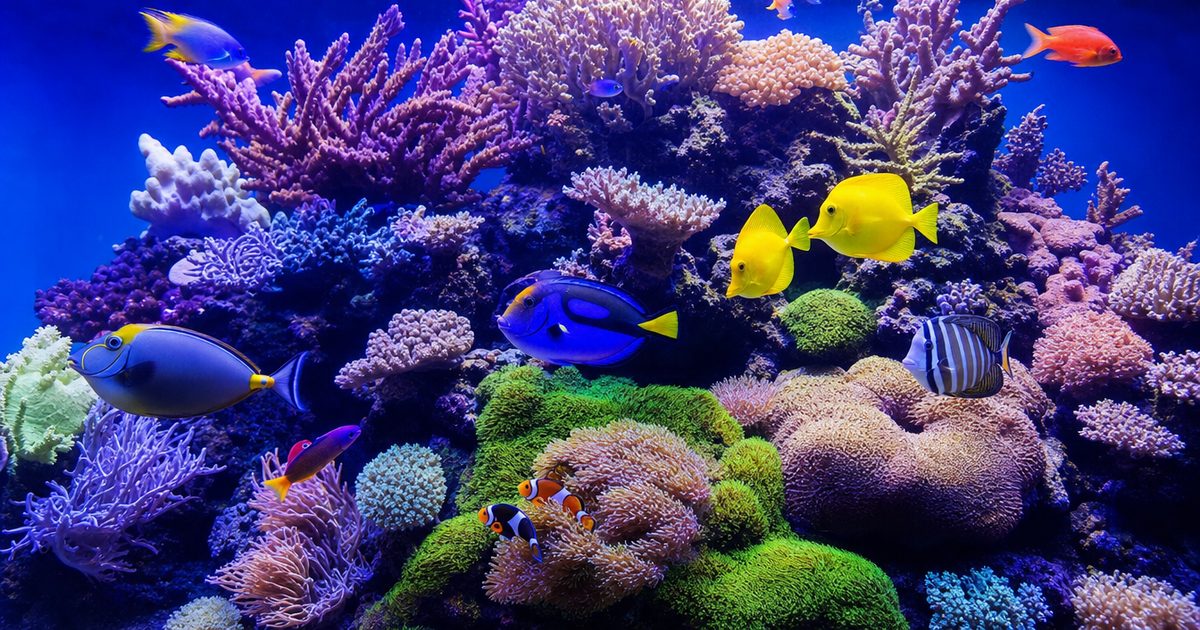
Before my first reef I’d kept freshwater for years — community tanks, and for a good stretch heavily planted tanks. So when I jumped into saltwater I walked in with the confidence of someone who “knew aquariums.” That confidence is exactly what crashed my first reef. Plenty of my freshwater habits transferred. A few of them actively hurt me, and a few things about saltwater genuinely surprised me. If you’re coming over from fresh like I did, here’s the honest map.
What transferred (the good news)
Some core skills carry straight across. The nitrogen cycle is the nitrogen cycle — ammonia to nitrite to nitrate, run by bacteria you have to grow before you stock. Water changes are water changes. The instinct to observe your animals daily, to notice when something’s “off” before a test confirms it, is just as valuable on a reef. And the basic discipline of not overstocking and not overfeeding applies to both. If you kept fresh well, you’re not starting from zero.
The temperament transfers too. Reefing rewards patient, observant people, and so does a good planted tank. The mindset of letting a system mature instead of forcing it served me well — eventually, once I relearned to apply it.
What surprised me (the part that humbled me)
Here’s where saltwater is its own animal:
Stability is in a different league. A planted freshwater tank is forgiving of swings in a way a reef simply isn’t. Corals react badly to parameter shifts that a hardy freshwater fish wouldn’t even notice. The whole “hold it steady, don’t chase numbers” obsession I write about constantly? That intensity is specific to saltwater. Coming from fresh, I badly underestimated how much steadier a reef needs to be.
Salinity is a parameter you didn’t have. In freshwater, water evaporates and you top it off and that’s that. In saltwater, evaporation leaves the salt behind and concentrates it, so the act of topping off has to use fresh water and has to be consistent — which is the entire reason an ATO exists. There’s a whole layer of salinity management that simply has no freshwater equivalent.
The protein skimmer has no freshwater cousin. This was the biggest gear surprise. There’s nothing in freshwater that does what a skimmer does — pulling dissolved organics out before they break down. In a planted tank, plants soak up a lot of nutrients. On a reef, the skimmer is doing heavy lifting that I’d never had to think about, and undersizing it (which I did, to save money) hurt me badly. It’s the one piece of reef gear I’d tell a freshwater convert to respect most.
Flow means something different. In my planted tanks, flow was about gentle distribution and not flattening the plants. On a reef, flow is life support — corals depend on strong, turbulent water movement in a way freshwater plants never did. I ran my first reef on planted-tank flow levels and the corals on the far side suffocated.
Lighting is about PAR, not looking nice. Planted tanks care about light too, but coming to reef I had to relearn it around PAR by coral type and a blue-heavy spectrum — and the over-lighting trap on a young tank, which causes algae just like it can in fresh but with higher stakes.
The mistake was assuming, not the freshwater itself
To be clear, the freshwater background wasn’t the problem — assuming it covered me was. I treated the cycle as a formality because I’d “done this before,” skimped on the skimmer because I didn’t grasp what it did, and ran weak flow because that’s what plants liked. Every one of those was a freshwater habit misapplied to a system that played by different rules.
If you keep freshwater and you’re curious about reef, do it — just come in humble. Respect that stability, salinity, skimming, flow and PAR all behave differently, and don’t let “I know aquariums” talk you out of going slow.
A quick note for the freshwater-curious: the planted/freshwater side of the hobby is a whole world of its own that I deliberately don’t cover here — for that, a dedicated freshwater resource like Planted Tank Hub is the better read. Coral & Flow stays strictly saltwater, because the two really are different enough to deserve separate homes.
The single piece of reef gear I’d most urge a freshwater convert not to skimp on is the skimmer — it’s the thing with no freshwater equivalent and the one I got most wrong. If you’re sizing one, the best protein skimmers guide compares them by rated volume and bioload so you give it real headroom from the start.
Come from fresh by all means. Just don’t bring the assumption that you already know how this one works.
This is general reef-keeping information drawn from my own experience and established references, not a prescription for your tank. Test your own water and follow each product’s instructions.