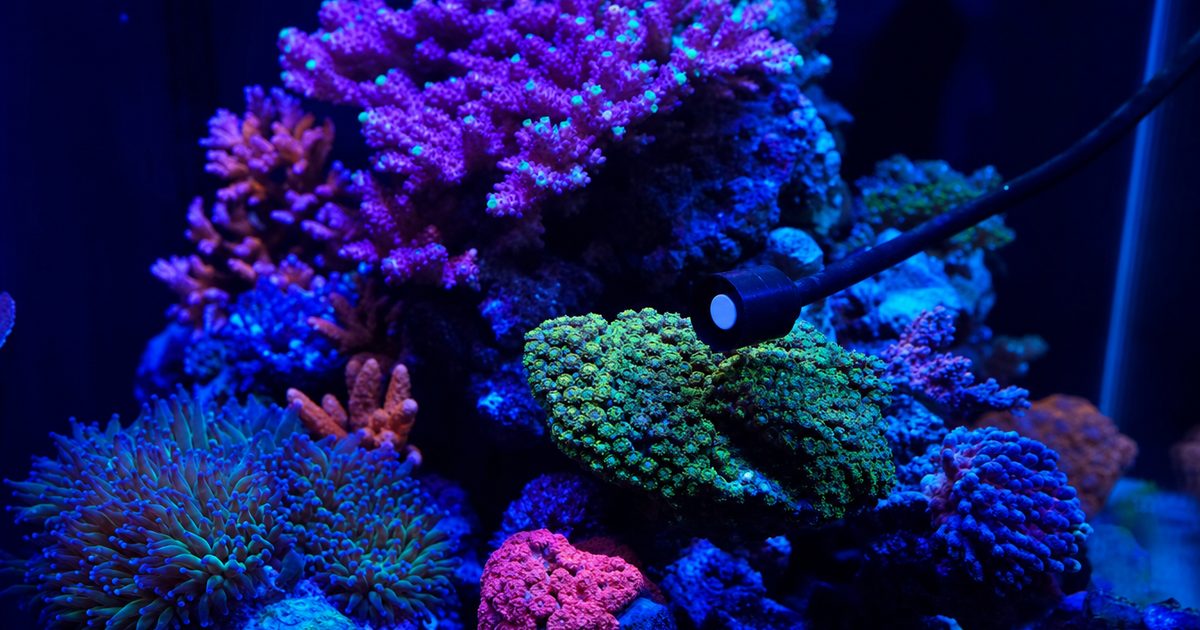
When I started out, I thought of reef lighting the way I thought of household bulbs: more watts, more light, brighter is better. That’s wrong on a reef in a couple of important ways, and getting it wrong either starves your corals or cooks them. The number that actually matters is PAR, and once it clicked for me, lighting stopped being guesswork.
Why watts are the wrong number
Watts measure how much electricity a fixture draws, not how much usable light reaches your corals. A power-hungry old fixture can deliver less useful light than an efficient modern LED that draws half the watts. And corals don’t care about brightness as your eye sees it — they care about the specific light their symbiotic algae can photosynthesize.
That’s where PAR comes in. PAR stands for Photosynthetically Active Radiation: the band of light corals’ zooxanthellae actually use to make energy. It’s measured in PPFD (those “PAR readings” you hear reefers quote), and it’s the closest thing we have to a real “how much light is hitting this coral” number. Spectrum matters too — reef corals do well under a blue-heavy spectrum that mimics the filtered light at depth — but PAR is the headline.
PAR targets by coral type
These are general target ranges drawn from established reef references and manufacturer guidance, not numbers I measured on a bench (I don’t claim PAR readings on specific fixtures — that’s lab-test territory I stay out of). Think of them as zones, not exact figures:
- Soft corals: the lowest light needs. They do well in lower PAR and many will actually look worse if you blast them. A modest range suits mushrooms, zoas and leathers.
- LPS: moderate PAR. Hammers, torches and acans want more than softies but get unhappy under full SPS-level light. Mid-range is the sweet spot.
- SPS: the light-hungry group. Acropora and friends want high PAR to color up and grow, which is why SPS keepers run stronger fixtures and place corals high in the tank.
Crucially, more light isn’t a freebie. Push a soft or LPS coral past its comfortable PAR and it bleaches, browns out, or closes up. The goal is matching the coral to the right zone in your tank, not maxing everything out.
The over-lighting trap on a new tank
Here’s the mistake I see (and made): cranking a brand-new fixture to full power on a young tank. A new reef hasn’t built up the biology to handle high light, and the predictable result is an algae bloom — the new-tank uglies, but worse. Strong light plus the spare nutrients of a young system equals algae winning the race against your corals.
What works better is ramping up slowly. I run my fixture on a gentle schedule that builds over the day, and when I added more SPS over the years I increased intensity gradually over weeks, not overnight. Corals acclimate to light changes slowly; rush it and you bleach them. Patience again — it’s the theme of everything I write here.
Coverage and mounting height
Two practical things that trip people up. First, coverage: a single fixture has a footprint, and PAR drops off toward the edges and corners. A long tank often needs two fixtures or a wider unit, or you end up with bright middle and dim ends. Second, mounting height: raising a fixture spreads the light wider but lowers the PAR reaching the corals; lowering it concentrates and intensifies. It’s a trade-off you tune to your tank’s depth and footprint.
Picking a fixture
I run a single LED fixture over my mixed reef and tune it by schedule and intensity. I won’t tell you I tested a rack of lights side by side — I haven’t. For the specs that actually decide the purchase (coverage area, spectrum, controllability, output class), the best reef lights guide compares fixtures by coral type so you can match output to whether you’re keeping softies, LPS or SPS.
The takeaway: stop thinking in watts, start thinking in PAR zones, match the coral to the zone, and ramp a new tank up slowly. Light is a tool you dial in, not a dial you max out.
PAR targets and spectrum guidance here come from established reef references and manufacturer specs, not bench measurement. These are general reef-keeping observations — acclimate corals slowly and watch how they respond.