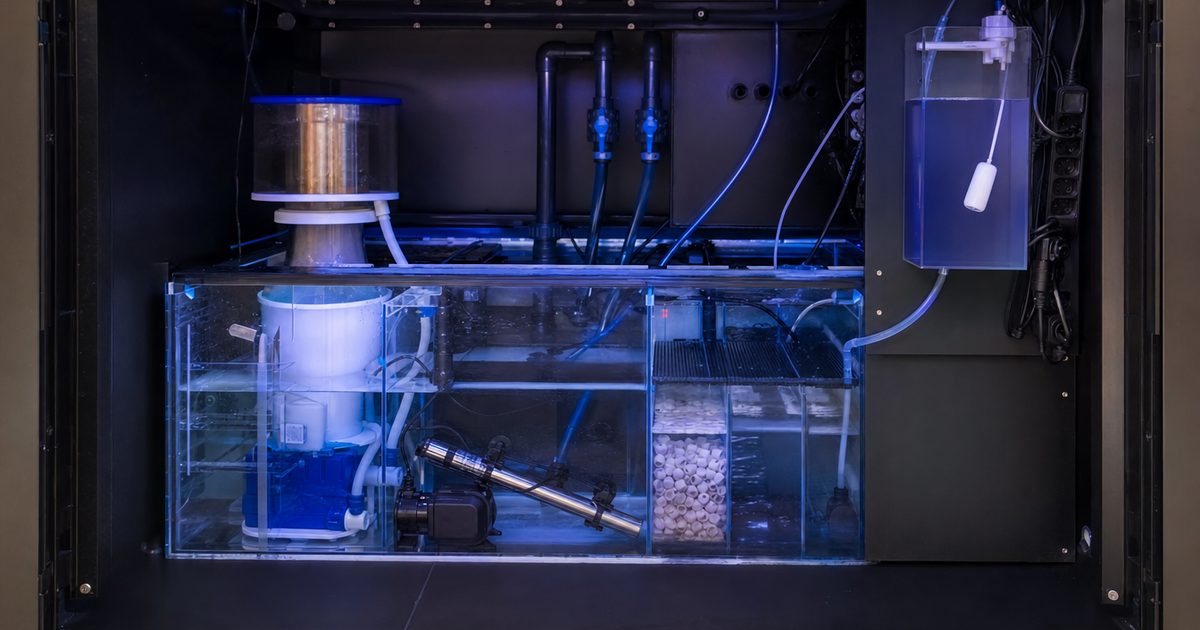
Nobody gets into reefing for the auto top-off unit. The exciting purchases are the corals, the light, maybe a fancy controller. But if I had to point at the gear that has actually saved my tank over eight-plus years, it’s the boring stuff: the ATO and a sensible heater setup. Stability gear keeps a reef alive — not the livestock.
The ATO: how I stopped salinity from swinging
ATO stands for Auto Top-Off. Here’s the problem it solves. Water evaporates from your tank constantly, but salt does not — it stays behind. So as the water level drops, the remaining water gets saltier. On a smaller tank, a day or two of evaporation can swing salinity enough to stress corals. Top off by hand and you’re forever chasing a moving target, especially if you travel.
An ATO is a sensor plus a small pump and a reservoir of fresh RO/DI water. When evaporation drops the level, it tops the tank back up with fresh water — replacing what evaporated, keeping salinity rock-steady. It’s the single best thing I did for day-to-day stability, and it directly fixed one of the things that made my first tank such a roller coaster.
The story I tell at the club: an ATO once saved a holiday. I was away for several days, summer evaporation was brisk, and without the ATO my salinity would have climbed steadily the whole time. Instead I came home to a tank that hadn’t noticed I was gone. That’s the whole pitch — boring gear that means nothing dramatic happens while you’re not looking.
A couple of setup notes from my own tank:
- Use a backup float or a controller with a failsafe. ATOs fail in two bad ways: stuck on (overfills, dilutes) or stuck off (level drops). A second sensor or a failsafe limits the damage either way.
- Top off with RO/DI only, never saltwater. The ATO replaces evaporated water, not salt.
- Size the reservoir to your evaporation and how long you’re away. Bigger reservoir, fewer refills, more holiday cover.
Heater redundancy: the failure that scares me most
A heater is the gear most likely to genuinely kill a whole tank, and it does it in two opposite ways. A heater stuck on cooks everything. A heater stuck off (or simply dead) lets the tank chill, and a sustained temperature crash is just as lethal. Either failure can wipe a reef overnight.
So I don’t trust a single heater on its own thermostat. The setup I run, and recommend, has a couple of layers:
- A reliable heater — I run titanium because it’s durable and doesn’t shatter like cheap glass ones, and titanium pairs naturally with an external controller.
- An external temperature controller that switches the heater on and off independently of the heater’s own (often inaccurate) built-in thermostat. The controller is the brain; the heater is just the muscle.
- Redundancy on bigger tanks: two smaller heaters instead of one big one. If one sticks off, the other holds you near temperature long enough to notice. If one sticks on, a smaller heater can’t overheat the tank as fast, buying you time.
That combination has caught a failing heater for me before it became a disaster. A single cheap heater on its own thermostat is the gamble I’m not willing to take on a tank full of living animals.
Boring gear is the point
I know none of this is glamorous. But the whole thesis of how I keep reefs is that the equipment, held steady, is what keeps the livestock alive — not constant intervention from me. The ATO holds salinity. The heater-and-controller holds temperature. They do the dull, relentless work of stability so I don’t have to babysit, and so a single failure doesn’t take the tank with it.
If you’re picking a heater, do it on the specs that matter — material, wattage for your volume, controller compatibility. The best reef tank heaters guide compares titanium heaters and controllers so you can build the redundant setup rather than gambling on one glass heater and hoping.
Buy the boring gear. It’s the stuff that’s quietly working at 3 a.m. while you sleep.
Heater and ATO guidance here is general reef-keeping information drawn from manufacturer specs and established practice, not a prescription for your specific tank. Always follow each product’s safety and installation instructions.