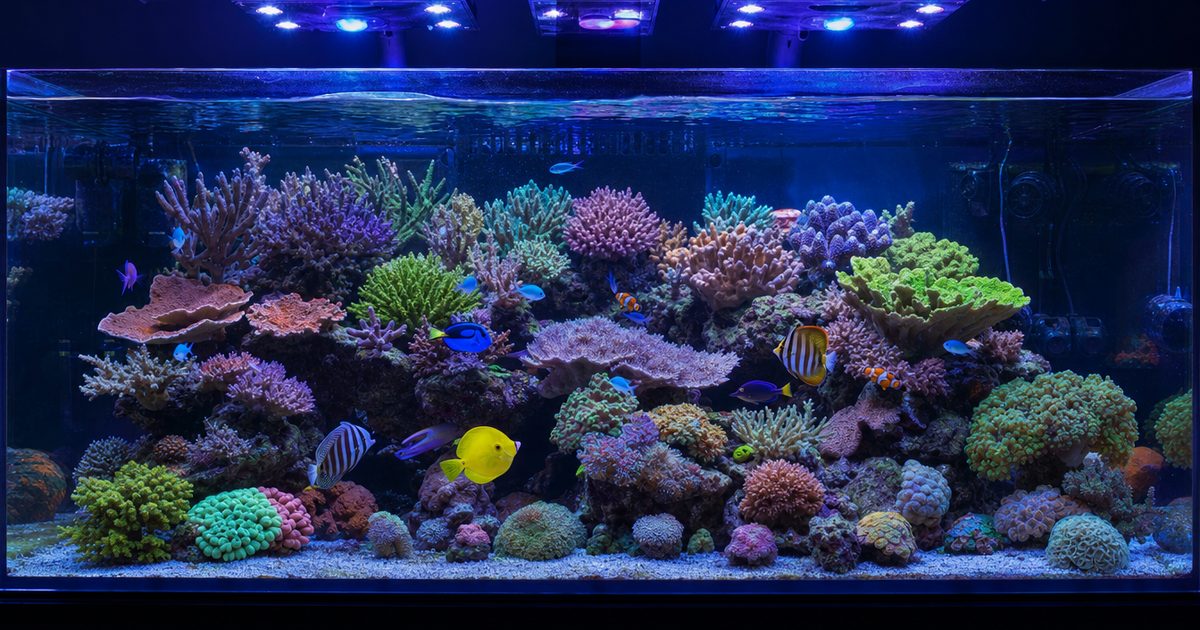
The single biggest shift in how I keep reefs wasn’t a piece of gear. It was learning to stop touching the tank so much. Early on I was a number-chaser — I’d test, see a reading that wasn’t “ideal,” and immediately do something about it. Dose, water change, adjust. I thought that was good husbandry. It was actually the thing keeping my reef on the edge of crashing.
The trap of the “perfect” number
Every beginner reads the same target ranges: salinity around 1.025, alkalinity in a certain dKH band, calcium and magnesium in theirs, and so on. So you test, you see a number slightly off the textbook ideal, and your brain screams fix it. You dose to nudge alkalinity up. The next day calcium looks a touch low, so you address that. Then alkalinity overshot, so you correct back. Each correction is a swing, and each swing is a stress event for every coral in the tank.
The corals don’t actually care that your alkalinity is exactly 8.3 dKH. What they care about is that it was roughly the same yesterday and will be roughly the same tomorrow. A reef held rock-steady at a slightly “off” number will almost always look better than one bounced around chasing the perfect number. Stability beats perfection. That sentence took me a crashed tank and a year of tinkering to actually believe.
What “chasing numbers” looked like for me
On my first tank, my daily routine was basically panic in slow motion. I’d test, react, test again, react again. Big water changes when something looked off. New additives every week. I was treating the reef like a patient in crisis when what it needed was to be left alone to find equilibrium. The more I intervened, the more unstable it got, and the more unstable it got, the more I intervened. That feedback loop crashes tanks.
The reefer at my club who helped me restart gave me one instruction that sounded almost lazy: “Test, write it down, and don’t change anything for two weeks unless something is genuinely dangerous.” It was the hardest and most useful advice I got. The tank settled. The corals opened up. Nothing dramatic happened, which was exactly the point.
How I keep things stable now
Stability isn’t about doing nothing — it’s about doing consistent, boring things and resisting the urge to react to every wobble.
- Consistency over correction. I test on a routine, I log the numbers, and I look for trends rather than reacting to single readings. One odd test is usually a test variance, not an emergency.
- Small, regular water changes instead of big rescue ones. A steady small change holds parameters far better than a giant swing.
- Automate the things that drift. An ATO holds salinity steady as water evaporates — top-off by hand and salinity yo-yos. A doser keeps alkalinity and calcium level for a growing reef instead of me adding a slug once a week and causing a swing. The boring stability gear, not me fiddling, is what holds the line.
- Change one thing at a time, slowly. If something genuinely needs adjusting, I move it gently over days, not all at once, and I wait to see the effect before doing anything else.
The mindset that actually works
The hardest part of reefing isn’t technical — it’s psychological. It’s sitting on your hands when a number looks slightly off and trusting that steady wins. The hobby attracts careful, conscientious people, and that same conscientiousness becomes the over-tinkering that crashes tanks. If you’re the kind of person who’s tempted to dose because a test looked imperfect, this post is for you, because that was me.
If you want the parameters that actually matter and the gear that holds them steady — heaters, ATO, dosing, test kits — that’s the whole point of the reef stability hub. It’s the stuff that keeps a reef alive when you finally learn to stop poking it.
Get the parameters stable, not perfect. Then go do something else and let the reef do its thing.
Target ranges and stability guidance here are general reef-keeping information drawn from established references, not a prescription for your specific tank. Always test your own water and follow each product’s instructions.