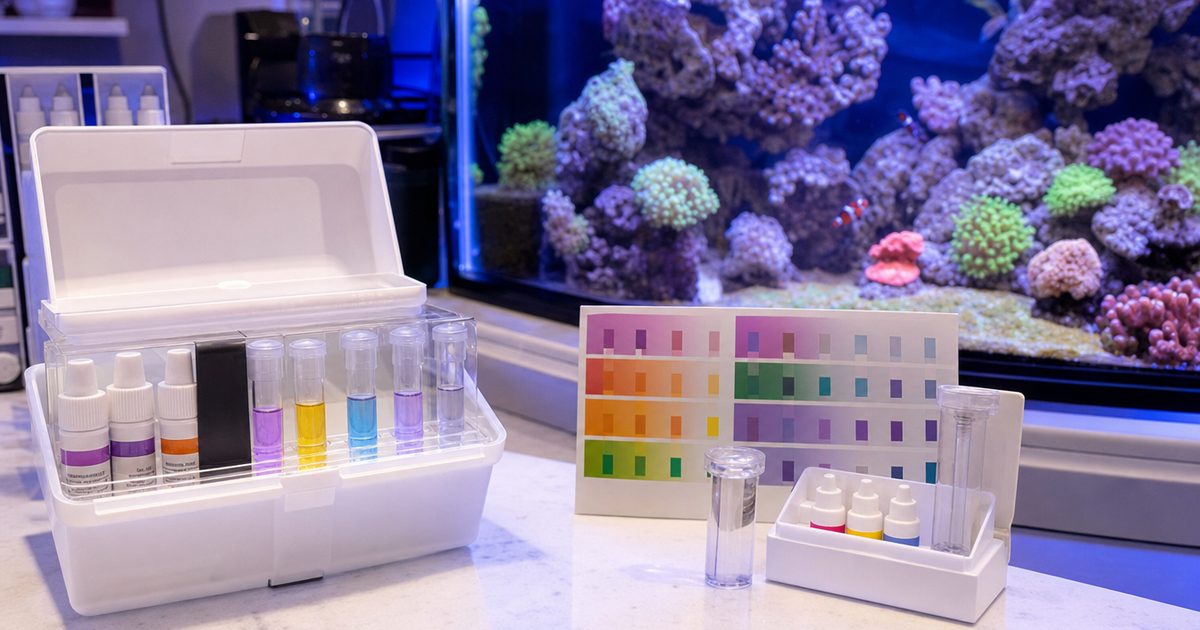
There’s a long list of things you can test on a reef tank, and beginners often end up either testing nothing or testing everything in a panic. After eight-plus years I’ve settled into a short routine: a handful of tests I actually run, on a rhythm, because they tell me something I’ll act on. Here’s that list, what each parameter means, and why I bother — or don’t.
Quick honesty note up front: these are general target ranges from established reef references, not numbers I bench-measured, and not a prescription for your tank. Test your own water and follow your kit’s instructions.
The tests I run on a routine
Salinity. I check this often, because it’s the foundation everything else sits on, and it’s the one that drifts on its own as water evaporates. I aim to keep it steady around natural seawater levels and — more importantly — steady, not bouncing. A refractometer (calibrated) or a good digital meter beats the cheap swing-arm hydrometers. An ATO holds it level between checks.
Temperature. Not a “test kit” parameter, but I watch it daily through my controller. Stable temperature matters as much as the right temperature. A reef held steady will outperform one that swings a few degrees day to night.
Alkalinity (dKH). This is the one I test most deliberately. Alkalinity is the carbonate buffer corals use to build skeleton, and it’s also the parameter that moves fastest as corals consume it. It’s an early-warning gauge: if alkalinity is drifting, my dosing or my consumption has changed, and I want to know. I test it on a regular cadence and log it so I’m watching the trend, not reacting to one reading.
Calcium and magnesium. These move slower than alkalinity, so I test them less often. Calcium is the other half of the skeleton-building equation; magnesium is the quiet enabler that keeps calcium and alkalinity both in solution. I check them periodically and after any change to my dosing, mostly to make sure they’re tracking together and nothing’s drifted.
Nitrate and phosphate. The nutrient pair. Contrary to what beginners assume, you don’t want these at zero — corals need some nutrients, and bottomed-out nutrients cause their own problems (pale corals, dinos). I test these to make sure they’re in a sensible low range, not absent and not climbing. If they’re climbing, that’s usually a sign my skimmer’s overwhelmed or I’m overfeeding.
What I don’t test routinely
There’s a whole world of trace-element and advanced testing, and for a mixed reef of softies, LPS and a few SPS, I don’t run most of it on a routine. I’ll test something specific if I’m chasing a specific problem, but I don’t test a dozen parameters weekly “just in case.” That way lies the number-chasing spiral I’ve written about before — more data than you’ll act on just becomes more anxiety. Test what you’ll actually respond to.
Trends beat single readings
The most useful change I made was logging results and watching the line, not the dot. Any single test has variance — your reagent’s a bit old, you read the color slightly differently, you didn’t mix the sample well. One “off” reading is almost never an emergency. A parameter steadily drifting over several tests is worth acting on, gently. Looking at trends stopped me reacting to noise.
Testing serves stability, not perfection
The reason I test at all is to keep things stable, not to hit textbook-perfect numbers. A reef held steady at a slightly-off-ideal alkalinity looks better than one yo-yoed around chasing the perfect figure. I test so I can catch real drift early and correct it slowly — that’s the whole job.
If you want the parameters laid out properly with the gear that holds each one steady — test kits, dosers, ATO, heaters — the reef stability hub ties it all together. Pair a routine you’ll actually keep with gear that does the holding for you, and the testing becomes a quick confirmation rather than a daily worry.
Test the few things you’ll act on, watch the trend, and let stability — not perfection — be the goal.
Parameter ranges and testing guidance here are general reef-keeping information from established references, not a prescription. Test your own water, calibrate your equipment, and follow each kit’s instructions. This is not veterinary advice.